

#72: Muhasaba Chart
How twenty-three years of private muhasaba turned a list of sins into a map of the heart.

In 2003 I was twenty-three, and my submission to Allah became conscious. I was a born Muslim and I had loved Allah since I was a child, but that year the submission became deliberate, alhamdulillah.
One of the first things I did was start a file.
I called it the sins chart. The idea was plain: find every sin I could, from the Qur’an, from hadith, from the books, write each one down, and check myself against the list. It lived in Excel. Over the years it grew into a daily practice: prayers across the top of the day, and below them the sins, grouped by the limb they pass through. Eyes. Tongue. Stomach. Limbs. And then the column that never behaved: the heart.
The body columns were easy. An eye either looked or it didn’t. But the heart column kept overflowing, and worse, its rows bled into each other. Ujub and kibr. Riya and love of status. Hirs and love of dunya. Where does self-admiration end and arrogance begin? I would catch myself in something and not know which row to mark, and a chart you cannot mark is a chart that has stopped working.
Here is the list, as it stood (more or less):
Self-exaltation and ego
Kibr — arrogance; seeing oneself as above others.
ʿUjb — self-admiration; being impressed with oneself.
Takabbur — actively exalting oneself.
Fakhr — boasting.
Khayalāʾ — vanity, self-importance.
Tazkiyat al-nafs — claiming purity or righteousness for oneself.
Ghurūr — self-delusion; being deceived about one’s own state.
Showing off and image management
Riyāʾ — showing off in worship or good deeds.
Sumʿah — seeking a reputation; wanting people to hear about your virtue.
Takalluf — artificiality, affectation, performing an identity.
Nifāq — hypocrisy; outward appearance contradicting inward reality.
Envy and resentment
Ḥasad — envy; wanting another’s blessing removed.
Ḥiqd — rancor, holding grudges.
Baghy — transgressive jealousy leading to injustice.
Shamātah — taking pleasure in another’s misfortune.
Anger and harshness
Ghaḍab — uncontrolled anger.
Qaswat al-qalb — hardness of heart.
Fuẓūẓah — harshness and roughness in dealing with people.
Intiqām li-nafsih — seeking personal vengeance for ego reasons.
Speech-related character sins
Ghibah — backbiting.
Namīmah — tale-bearing, stirring conflict.
Sukhriyah — mocking or ridiculing people.
Istihzāʾ — derision and contemptuous mockery.
Laghw — pointless or harmful speech.
Kadhib — lying.
Buhtān — slander; false accusations.
Mirāʾ — arguing to win rather than to reach truth.
Jidāl (blameworthy forms) — excessive disputation.
Love of status and power
Ḥubb al-jāh — love of status, rank, prestige.
Ḥubb al-riʾāsah — love of leadership and being above others.
Taʿaẓẓum — seeking greatness.
Takāthur — rivalry in worldly superiority.
Deficiencies in relationship with Allah
Qunūṭ — despair of Allah’s mercy.
Amn min makr Allāh — feeling completely safe from Allah’s accountability.
Riyāʾ — worship for people rather than Allah.
Kufr al-niʿmah — ingratitude for blessings.
Tawakkul deficiency — relying on oneself while neglecting trust in Allah.
Deficiencies in relationship with people
Ẓulm — oppression or injustice.
Khiyānah — betrayal of trust.
Ḥasad — envy.
Ḥiqd — grudges.
Takabbur — looking down on others.
Iḥtiqār al-nās — despising people.
Look at it closely and you will feel that something is not right. The format flattens the meanings; each line tries to explain the Arabic and loses it in the explaining. And the failure is written on its face: Riyāʾ appears twice, once under showing off and once under the deficiencies with Allah. Ḥasad appears twice. Ḥiqd twice. Takabbur twice. I did not write them twice by mistake. The list forced me to, because the same disease kept belonging in more than one box. I was asking a flat format to hold something that was never flat, and the duplicates were the format breaking under the load.
And this is not a confession about one old Excel file. The same lists, or near copies of them, circulate everywhere today: on websites, in pamphlets, and now in AI-generated answers, which reproduce the same flat shape with the same loose glosses. The failure then compounds in a fixed order. The language is not precise, so the assessment is not precise, so there is no real improvement. A sincere person sits down with such a list to fix himself and finds the work exhausting, because the tool cannot tell him where one disease ends and another begins, let alone which root keeps feeding his particular fall. The exhaustion comes from the instrument, not from any weakness in him.
Before the chart taught me anything about myself, it taught me about words. I was collecting the sins in Arabic and filing them under English names, and the English kept misleading me. Each language carries its own burden of meaning, and the burden travels with the word. Pride, arrogance, envy, vanity: these have English histories, and none of them is the disease itself. Kibr is not pride. The Prophet ﷺ defined it, and the definition is the diagnosis:
الْكِبْرُ بَطَرُ الْحَقِّ وَغَمْطُ النَّاسِ
Kibr is rejecting the truth and despising people (Muslim 91a).
Read it twice. Nothing in it requires a raised chin or a loud voice. A quiet, modest, soft-spoken man rejects a correction because of who it came from, and the hadith has already named him. The same held across the chart: shuhh is heavier than the English “stinginess,” for the Prophet ﷺ tied it to bloodshed and to making the unlawful lawful (Muslim 2578). So the chart acquired its first rule, years before it had any structure: the hadith’s definition is the definition. The translation is only a label on the box.
It took me years to see why.
A list gives every sin its own slot. But watch a single lie. It can grow from fear of people, from greed, from protecting an image, from hypocrisy, from plain heedlessness. One fruit, several roots. The list assumes each sin is one thing; the heart routes many roads to the same act. The chart was failing because the format was wrong, and the format was wrong because I was writing down fruits and treating them as roots.
So, slowly, the list became a map.
At the bottom sit the fruits, sorted by where they become visible: the tongue, wealth, relationships, image and status, the body, and worship itself. Above them sit the diseases that feed them. And above the diseases, one fracture: the lived meaning of لا إله إلا الله. The Qur’an states the baseline in one verse:
يَا أَيُّهَا النَّاسُ أَنتُمُ الْفُقَرَاءُ إِلَى اللَّهِ ۖ وَاللَّهُ هُوَ الْغَنِيُّ الْحَمِيدُ
O mankind, you are the ones in need of Allah, and Allah, He is the Sufficient, the Praised (Q 35:15).
Even here the common translation flattens. Faqir is not the poor man of the English word; it is the one who needs by his very nature, in every breath, whether his accounts are full or empty. And Ghani is not rich. Riches can be lost. Ghani is sufficiency that has no fear of ever becoming needy, sufficiency that nothing can touch. The verse sets the two natures against each other, need by essence and sufficiency by essence, and engine one, seen this way, is a creature pretending to the attribute of al-Ghani.
The day I stop living that need in practice, two engines start. One is aggressive. It deems itself sufficient:
كَلَّا إِنَّ الْإِنسَانَ لَيَطْغَىٰ أَن رَّآهُ اسْتَغْنَىٰ
No indeed, man transgresses, that he deems himself self-sufficient (Q 96:6-7).
The other engine is quiet. It just forgets, drifts, builds habits, loses feeling, and hardens:
كَلَّا ۖ بَلْ رَانَ عَلَىٰ قُلُوبِهِم مَّا كَانُوا يَكْسِبُونَ
No indeed, rather what they earned has rusted upon their hearts (Q 83:14).
but,
Submission can doubt, and submission can drift.
Desire bridges the two, أفرأيت من اتخذ إلهه هواه, “have you seen the one who takes his desire as his god” (Q 45:23), and a hardened heart converts the one engine into the other.
Years after I had drawn this for myself, I read Ibn Taymiyya’s Diseases of the Hearts and Their Cures. He builds everything on two roots: doubts that corrupt the heart’s judging, and desires that corrupt its wanting. I sat with that for a while. If I had read him first, I would simply have copied him. His doubts wore the clothes of his century, churchmen and rationalists; ours wear self-sufficiency, a civilisation that has mastered enough of nature to deem itself its own god. Same root, different occupant. That is my reading of the age, not a measurement, so hold it lightly.
Ghazali was there from the beginning. When I filled the chart twenty-three years ago, the Ihya was one of the books I mined for it, and he had catalogued the orchard nine centuries before my Excel file: the destroyers (muhlikat) walk almost domain by domain, appetite, tongue, anger and envy, wealth, status. He was doing exactly what a physician should do. His book is a symptom list by design, each disease given its signs, its causes, its cures, chapter by chapter, because a treatment manual sorts by what the patient presents with. My chart needed a different instrument, a map of causes, and that is the only place we part. Kibr and ujub are two chapters in his book because they are detected and treated differently; they are one node in mine because, to my eye, both grow from the same defect in tawhid, the gift read as self-proof. Different books for different jobs. His heals the patient; mine tries to show where the illness began.
The full result is in the document attached below: the master map of the diseases and their fruits, the matrix that shows how one fruit takes several parents, and the restoration map, which matters more than the other two. Because the same hinge that breaks the heart heals it. The cure is not a second system. It is the first verse every Muslim already recites:
إِيَّاكَ نَعْبُدُ وَإِيَّاكَ نَسْتَعِينُ
You alone we worship, and You alone we ask for help (Q 1:5).
What has changed, twenty-three years on, is the depth of the troubleshooting. A list could only tell me that I fell. The map tells me why I keep falling in the same place: walk upstream from the fruit and one of the two engines is always running. And it tells me trajectory, where a thing goes if I leave it alone, because nothing in the heart stays the same size. The Prophet ﷺ warned about exactly this compounding: إياكم ومحقرات الذنوب, beware the belittled sins, for they gather upon a man like sticks gathered in a valley until there is fire enough (Ahmad, graded sahih). And the far end of that road is the worst of it: “then the end of those who did evil was the worst end, for they denied the signs of Allah” (Q 30:10). A desire can carry a man all the way to disbelief. It just takes the long way.
I have watched the gradient in myself. A drift begins as a pleasure. Repeated, the pleasure becomes a shahwa, an appetite. Fed, the shahwa becomes a shawq, a longing. And the sign of shawq is brutally simple: it is the first thing in your mind when you wake up. That place belongs to Allah. Of all the diagnostics the chart ever gave me, the morning thought is the cleanest.
I was twenty-three when the chart began. The chart is twenty-three now. It still has no finish line, and it was never supposed to. Muhasaba is not a project you complete. It is the daily question the chart was always asking: where am I, today, between the between the need I was made for and the sufficiency I keep imagining.
By the way, you can see the pdf and maps here
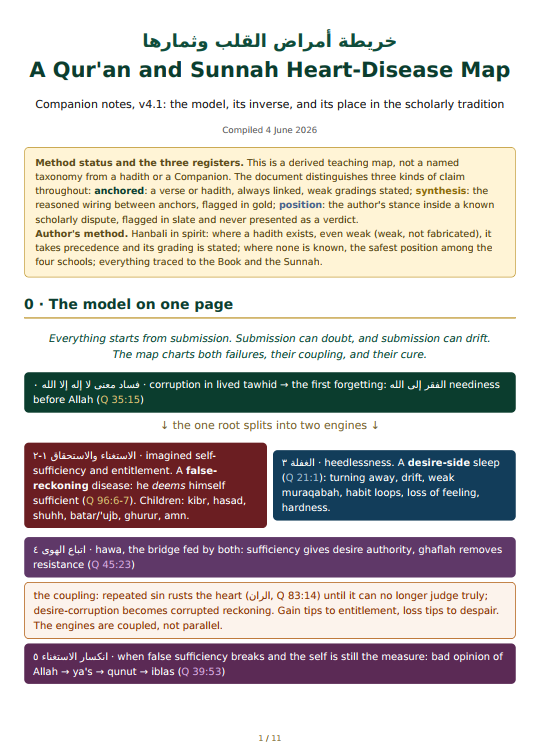
This is something that every child above age 10 must have on his table
Alhamdulillah. This is amazing and deeply helpful. Jazak Allah Khair