

#69.5: The Three Jerusalem
How Three Eschatologies That Despise Each Other Need the Same Fire

Fifth in a series. “The Engineered Friction” documented convergent destruction and the Hard State. “The Trigger Point” traced the war-finance coupling and identified three clocks. “The Board Holds” ran the model with war-suppression active: 63.4 basis points against 396 of headroom, zero crossings, and ended with the coupled configuration at 516 basis points against 168. “The Third Clock” tested whether household withdrawal breaks the system (it does not, at 58 basis points), interrogated what the model misses, and found that the exit runs through a biological energy system no economic model tracks. This piece goes underneath all four: the theological bedrock that makes the convergence operate at the level of belief, not just strategy.
1 | Why This Piece Exists
Strategy responds to cost. When the cost exceeds the benefit, strategy changes. That is the basis of every diplomatic framework, every sanctions regime, every deterrence theory. Change the incentives, change the behavior.
The previous four pieces identified a problem with that assumption. Three actors carry foundational frameworks, two theological and one material-theological, that make sustained Middle Eastern conflict not just strategically useful but cosmologically necessary. “The Third Clock” demonstrated that the material substrate can be changed through distributed withdrawal at quantified cost. But to understand what the withdrawal must outlast, you have to understand what each eschatology actually requires.
This analysis does not attempt to resolve debates about the authenticity of individual narrations. It examines how motifs preserved in the textual tradition shape eschatological imagination and, through that imagination, shape the actions of states.
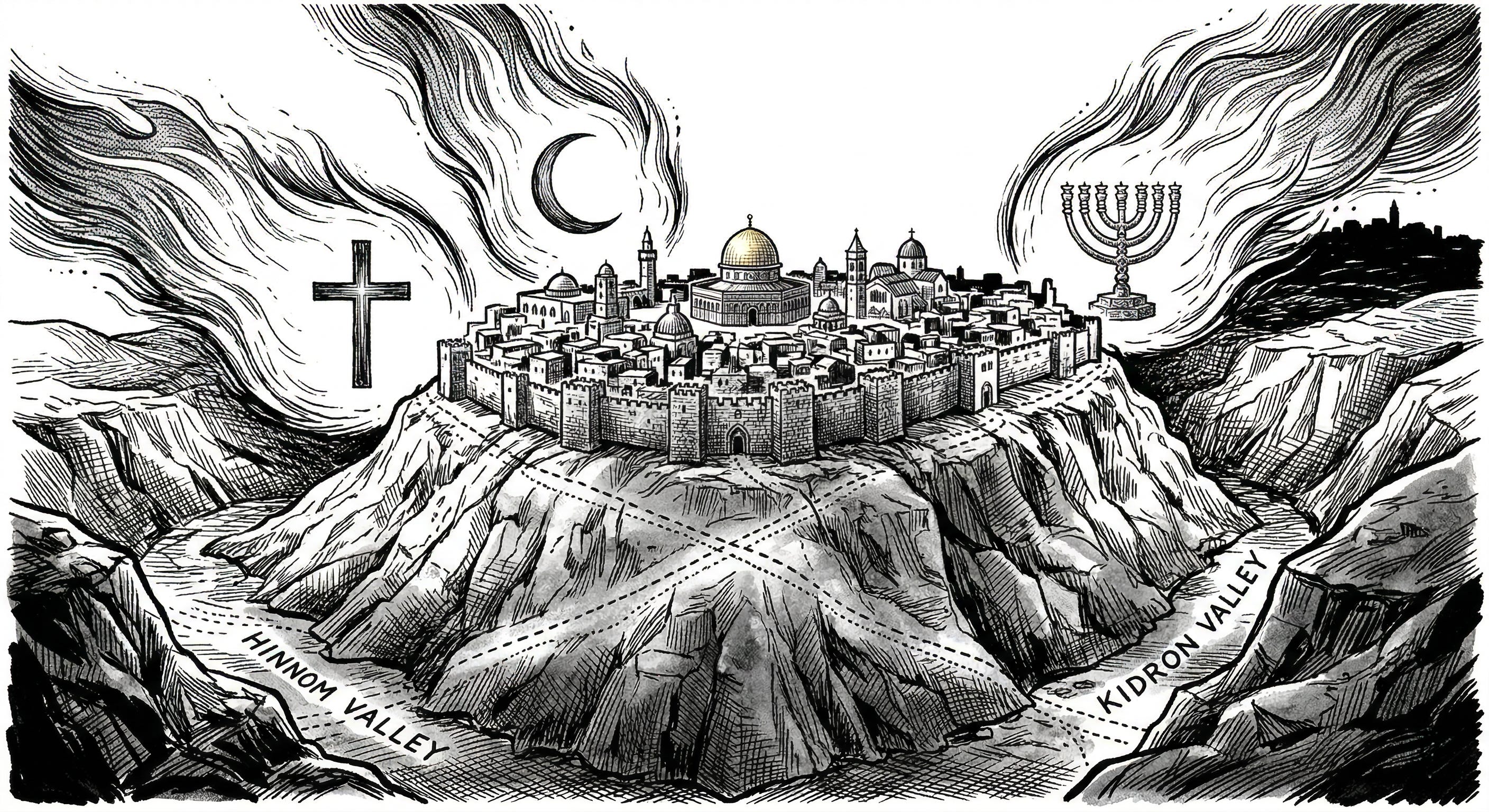
2 | The First Jerusalem: Greater Israel and the Restored Temple
The Textual Record
The territorial claim begins in Torah, but not in one place. Four passages define boundaries, and they do not agree with each other.
Genesis 15:18-21 records the Covenant of the Parts (Brit Bein HaBetarim): “On the same day the Lord made a covenant with Abram, saying: To your descendants I have given this land, from the river of Egypt to the great river, the River Euphrates -- the Kenites, the Kenezzites, the Kadmonites, the Hittites, the Perizzites, the Rephaim, the Amorites, the Canaanites, the Girgashites, and the Jebusites.” Ten peoples named. The territory, mapped geographically, spans present-day Egypt (Sinai), Israel/Palestine, Lebanon, Syria, Jordan, and extends deep into Iraq.
Joshua 1:4 echoes it: “From the wilderness and this Lebanon as far as the great river, the River Euphrates, all the land of the Hittites, and to the Great Sea toward the going down of the sun, shall be your territory.” Rabbinic tradition holds the Israelites did not possess the full extent of this grant until the reign of David.
Numbers 34:1-12 tells a different story. The Priestly boundaries are far more constrained: southern border from the Desert of Zin along Wadi el-Arish to the Mediterranean; western border along the coast; northern border from the sea to Mount Hor to Lebo-Hamath to Hazar-Enan; eastern border down through Shepham and Riblah to the eastern shore of the Sea of Galilee, then the Jordan to the Dead Sea. Approximately 160 miles long, 50 miles wide. Roughly the territory of modern Israel, the West Bank, and a strip of southern Lebanon. No Euphrates. No Mesopotamia. No Sinai.
Deuteronomy 1:7-8 and 11:24 use the expansive version again, matching Genesis.
The “River of Egypt” itself is contested. Rashi (Rabbi Shlomo Yitzchaki, 1040-1105 CE), in his commentary on Genesis 15:18, identifies it as the Nile, but acknowledges that Numbers 34:5 and Joshua 15:4 call the southern boundary “Wadi of Egypt” -- which most scholars identify as Wadi el-Arish, a seasonal waterway about 50 miles south of Gaza. Nachmanides (Rabbi Moshe ben Nachman / Ramban, 1194-1270) follows the Oral Tradition and integrates kabbalistic interpretation, treating the boundaries as layered in meaning. The Sifrei on Deuteronomy (c. 300 CE, Tannaitic period) provides the earliest sustained halakhic commentary on the boundary descriptions.
Two maps emerge. The maximalist reading (Genesis 15:18, Joshua 1:4, Deuteronomy) draws a territory from the Nile to the Euphrates. The priestly reading (Numbers 34) draws something far smaller. The theological and political question is which map governs.
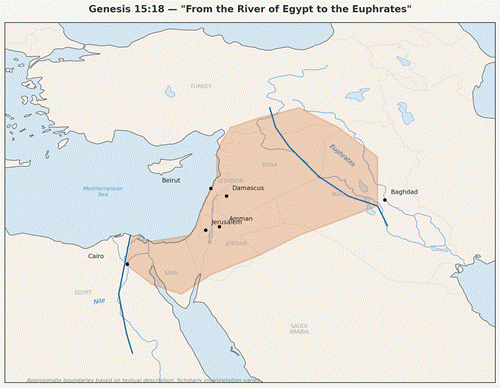
Genesis 15:18 -- “From the River of Egypt to the Euphrates.” Approximate boundaries based on textual description.
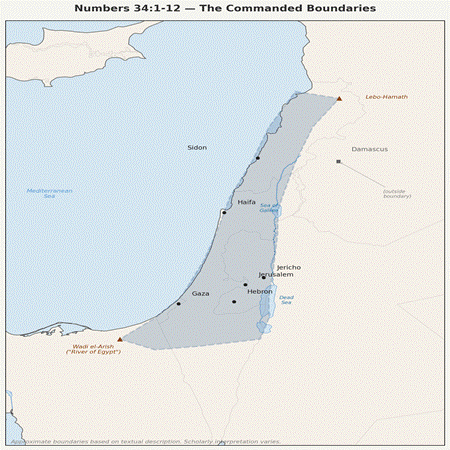
Numbers 34:1-12 -- The Commanded Boundaries. Approximate boundaries based on textual description.
Redemption Through Transgression
The theological move that makes Religious Zionism operate i.e., the claim that profane action serves sacred ends, has a specific lineage within Jewish mysticism.
Sabbatai Zevi (1626-1676), an Ottoman rabbi from Smyrna, declared himself the Messiah and built a movement that engulfed virtually the entire Jewish world. His theology, developed by his prophet Nathan of Gaza, drew on Lurianic Kabbalah’s concept of tikkun (cosmic repair): divine sparks were trapped within impure shells (qlippot), and the Messiah must descend into sin itself to release them. The doctrine was called mitzvah ha’ba’ah ba’averah, redemption through transgression. When Sabbatai Zevi converted to Islam under Ottoman pressure in 1666, his followers did not abandon him. They reinterpreted the apostasy as proof of the doctrine: the Messiah had entered the deepest impurity to redeem it. Jacob Frank (1726-1791) pushed this further. He claimed to be Sabbatai Zevi’s reincarnation and taught that the existing religious and social order must be destroyed as a precondition for redemption. Frank’s followers engaged in deliberate violation of Torah law, by ritualized transgression, as mystical labor toward the messianic age.
Gershom Scholem, in Sabbatai Sevi: The Mystical Messiah (Princeton, 1957/1973) and his essay “The Holiness of Sin” (Commentary, 1971), argued that Sabbateanism destabilized rabbinic authority and prepared the intellectual ground for the Haskalah (Jewish Enlightenment), which prepared the ground for secular Jewish nationalism, which prepared the ground for Zionism. The chain runs through intellectual history, not through secret transmission. The structural parallel is visible: profane action serving sacred ends. Whether Rabbi Abraham Isaac Kook drew on this lineage consciously or arrived at it independently is not documented in his writings.
The Theological Engine: Kook to Gush Emunim
Kook (1865-1935), the first Ashkenazi Chief Rabbi of British Mandatory Palestine, welded secular Zionism to messianic redemption. His principal work Orot (Lights, 1920) opens with Eretz Yisrael, these are eight short essays on the mystical bond between the Jewish nation and the land. When it was published, his opponents in Meah Shearim bought up the entire edition to suppress it, plastering excerpts on walls as evidence of heresy. In Orot HaTechiyah (Lights of Revival), Kook described materialism as generating “birth pangs of the Messianic era” and characterized the secular Zionist pioneers as the chamor shel mashiach (Donkey of Messiah), an imperfect but divinely necessary instrument. Secular pioneers, by their physical labor on the land, were unknowingly advancing divine redemption. Their irreligiosity did not disqualify them. It made them instruments. Kook’s framework follows the same structural logic as the Sabbatean pattern, applied within Orthodox theology.
His son Rabbi Zvi Yehuda Kook (1891-1982) radicalized this into territorial doctrine from Merkaz HaRav Yeshiva, which the elder Kook had founded in Jerusalem in 1924. The younger Kook’s most cited utterance came on Israel Independence Day, May 1967, three weeks before the Six Day War. He demanded of his students: “Where is our Hebron? Where is our Shechem? Where is our Jericho?” When Israel captured those cities three weeks later, his students treated the speech as prophetic confirmation. He taught that “giving up any part of the inheritance of our fathers” was “a sin and a crime,” and that building settlements in the Land of Israel was “not bitul Torah [wasting Torah study] but Torah itself.” He noted the shared root of yeshiva (house of study) and yishuv (settlement). His teachings are collected in Eight Letters of Rabbi Zvi Yehuda Kook (ed. Hagay Shtamler, Carmel, Jerusalem, 2002; English translation by Bezalel Naor).
In February 1974, in the living room of Rabbi Haim Drukman (who coined the name), Zvi Yehuda’s students founded Gush Emunim (Bloc of the Faithful). Core members were, Hanan Porat, Moshe Levinger, Shlomo Aviner, Menachem Froman, Eliezer Waldman, Yoel Bin-Nun, Yaakov Ariel. The Yom Kippur War (1973) had shaken secular Israeli confidence; Gush Emunim offered a theological counter-narrative in which both the 1967 conquests and the 1973 trauma confirmed the messianic process. Their settlement-building arm, Amana, was founded in 1976 and continues to supervise construction, purchase land, and establish outposts. The Yesha Council, established in 1981 as the umbrella for 25 elected municipal councils, represents over 500,000 settlers and functions as the political arm. In practice it is controlled by four regional power centers, Shomron, Binyamin, Gush Etzion, and Mount Hebron. All core leaders hold to the Eretz Yisrael HaShlema ideology.
Kahane
Rabbi Meir Kahane (1932-1990) stated explicitly what the Kook-Gush Emunim framework left implicit. In They Must Go (Grosset & Dunlap, 1981), written during a six-month sentence in Ramla prison, Kahane argued that a Jewish democratic state was a structural contradiction, a permanent Jewish majority requires the removal of Arabs. He offered three options namely, accept non-citizenship, leave voluntarily with $40,000 compensation, or face forcible expulsion. The book also proposed segregated education and housing, a ban on interfaith relationships, and a halakhic theocracy governed by rabbinical courts. In Uncomfortable Questions for Comfortable Jews (Lyle Stuart, 1987), he called Israel “schizophrenic” for wanting both Zionism and Western democracy, arguing they were “in total conflict.”
His party Kach was banned in 1988 under anti-racism legislation. He was assassinated in 1990. Itamar Ben Gvir, Israel’s current National Security Minister, was previously convicted of supporting Kach and incitement to racism. The ideology Kahane articulated now holds cabinet positions in the Israeli government.
The Temple Program
The Temple Institute, founded in 1987 in Jerusalem and led by Rabbi Chaim Richman, has moved from theological aspiration to material preparation. It has completed to date, detailed architectural plans and models of the Third Temple; a reconstructed menorah, incense altar, and showbread table; the Tzitz (High Priest’s golden crown, completed 2007); the Hoshen (breastplate) and Ephod; a modular altar designed for rapid assembly; and full priestly garments for the Kohanim, with training programs underway for descendants of the priestly line. In September 2022, five unblemished red heifers were imported from the United States and inspected for compliance with the parah adumah purification requirement. Parah adumah ritual is the precondition for Temple service.
The construction of the Third Temple on Haram al-Sharif (the Temple Mount / Al-Aqsa compound) requires, at minimum, Jewish sovereignty over the site and, in most formulations, the removal of the Dome of the Rock and Al-Aqsa Mosque. Gershom Gorenberg documents this convergence in The End of Days: Fundamentalism and the Struggle for the Temple Mount (Oxford University Press, 2002), showing how Jewish messianists treat building the Temple as essential for the Messiah’s arrival, while Muslim authorities understand that Third Temple construction on the site requires the demolition of what stands there now.
Strategic Doctrine
In February 1982, Oded Yinon, a former senior advisor at the Israeli Ministry of Foreign Affairs, published “A Strategy for Israel in the 1980s” in the Hebrew journal Kivunim. The paper proposed that Israel’s strategic interest lay in the fragmentation of surrounding Arab states along ethnic and confessional lines. Iraq into Sunni, Shia, and Kurdish components. Syria into Alawite, Sunni, Druze, and Kurdish zones. Lebanon already fragmented. Egypt weakened. Whether the paper functions as blueprint, analysis, or coincidence is debated. The fragmentation of Iraq along sectarian lines, the collapse of Syria into multiple zones, and Lebanon’s degradation are documented.
The Likud Party’s original 1977 platform stated: “Between the Sea and the Jordan there will only be Israeli sovereignty.” And: “The right of the Jewish people to the land of Israel is eternal and indisputable... Judea and Samaria will not be handed to any foreign administration.” Menachem Begin ran on annexation. Once in office he traded Sinai for the Egypt-Israel peace treaty (1979). One way to read the pattern: the theology sets the ceiling, the diplomacy sets the floor, and the settlement program expands into the space between.
Institutional Access
Bezalel Smotrich, Finance Minister, has publicly stated support for a Greater Israel extending “from the Nile and the Euphrates” and potentially to Damascus. He controls planning and construction authority in Area C of the West Bank. Itamar Ben Gvir, National Security Minister, has conducted provocative visits to the Temple Mount while advocating to change the site’s status quo. Daniella Weiss, the veteran settler leader, has stated on record: “We know from the Bible that the real borders of Greater Israel are the Euphrates and the Nile.”
The settler population has expanded to over 700,000 in the West Bank and East Jerusalem (Peace Now; B’Tselem settlement data). Settlement expansion continues during the current war under Smotrich’s policy authority.
For critical scholarship please read, Idith Zertal and Akiva Eldar, Lords of the Land: The War Over Israel’s Settlements in the Occupied Territories (Nation Books, 2007). For boundary theology: the Rashi and Nachmanides commentaries on Genesis are available through Sefaria.org.
What the First Jerusalem Requires
The Greater Israel endstate requires:
territorial expansion across biblical boundaries (requiring the weakening or collapse of neighboring Arab states).
Jewish sovereignty over the Temple Mount (requiring the displacement of Islamic authority over the site).
Muslim infighting and regional fragmentation (reducing collective capacity to resist expansion).
The theological legitimization of settlement as divine obligation (overriding international law, Palestinian rights, and secular Israeli strategic calculation).
The current war advances conditions consistent with each of these requirements. The destruction of neighboring state capacity (Syria, Lebanon, Iraq already degraded) advances the first. The war’s escalatory dynamic increases Israeli security control over Jerusalem, advancing the second. Regional chaos and Sunni-Shia conflict advance the third. The war’s existential framing strengthens the theological-nationalist narrative against secular pragmatists within Israeli politics, advancing the fourth.
3 | The Second Jerusalem: The Rapture and the Millennial Kingdom
The Textual Record
Before Herzl published Der Judenstaat in 1896, American Christians had already petitioned for Jewish restoration to Palestine. In March 1891, William Blackstone presented a memorial to President Benjamin Harrison signed by 431 prominent Americans including, J.P. Morgan, John D. Rockefeller, future President William McKinley, Chief Justice Melville Fuller, and the editors of the New York Times, Chicago Tribune, Boston Globe, Philadelphia Inquirer, and Washington Post. The petition asked: “Why not give Palestine back to them again? According to God’s distribution of nations it is their home, an inalienable possession from which they were expelled by force.” The theological commitment to Jewish restoration in Palestine preceded Jewish political Zionism by five years.
The theological system behind that commitment was built by John Nelson Darby (1800-1882), an Anglo-Irish clergyman who developed premillennial dispensationalism in the 1830s-1840s. Darby’s key innovation was a sharp separation between God’s purposes for Israel and God’s purposes for the Church. Prior Christian eschatology merged the two: the Church inherited Israel’s promises. Darby cut them apart. Israel retained a distinct national destiny, including literal restoration to the land and a future role in prophetic events. The Church had a separate, heavenly calling. And the bridge between the two was the rapture: the sudden, secret removal of believers from the earth before the tribulation begins, drawn from 1 Thessalonians 4:16-17. Darby published his framework across multiple volumes, principally his Synopsis of the Books of the Bible (1857-1862), and established it through the Plymouth Brethren movement.
C.I. Scofield embedded this framework into the margins of the Bible itself. The Scofield Reference Bible (Oxford University Press, 1909; revised 1917) sold over two million copies by the early 1940s and more than ten million over its lifetime. Its innovation was structural: the footnotes provided an interpretive framework that presented dispensational reading as the natural meaning of the text. Scofield identified seven dispensations i.e., Innocency, Conscience, Human Government, Promise, Law, Grace, and the Kingdom, each representing a distinct period of divine dealing with humanity. The seventh, the Kingdom, was future: the millennial reign of Christ on earth, centered in Jerusalem. Genesis 12:3 -- “I will bless those who bless you and curse those who curse you” -- was annotated as applying not to Abraham’s immediate family but to the modern nation-state of Israel. The Scofield Bible became the standard text in American Bible colleges, seminaries, and evangelical churches for most of the twentieth century. Dallas Theological Seminary, founded in 1924 by Lewis Sperry Chafer, became the institutional center for training dispensationalist pastors, with faculty including John Walvoord and Charles Ryrie producing the systematic theological literature that gave the framework academic architecture.
Hal Lindsey’s The Late Great Planet Earth (Zondervan, 1970, with Carole C. Carlson) brought this system to mass audiences. Thirty-five million copies. Translated into 54 languages. Named the bestselling nonfiction book of the 1970s by the New York Times. Lindsey connected the 1948 founding of Israel to Matthew 24:32-34, “when you see the fig tree put forth leaves, know that summer is near”, and argued that the generation alive in 1948 would see the fulfillment of all prophecy. The Soviet Union was identified with Gog (Ezekiel 38-39). Middle Eastern wars were interpreted as prelude to Armageddon. The rapture was imminent.
Tim LaHaye and Jerry Jenkins dramatized the sequence in the Left Behind series (Tyndale House, 1995-2007). Sixteen novels. Over 80 million copies. The fictional Antichrist, Nicolae Carpathia, rises through the United Nations. A one-world government and economy form. The tribulation unfolds over seven years. Christ returns. Armageddon is fought in the Valley of Megiddo. The millennial kingdom begins. The series normalized rapture expectation among an entire generation of American evangelicals and made the dispensationalist sequence the assumed eschatological framework rather than a contested theological position.
The Prophetic Sequence
The specific timeline, drawn from Darby through Scofield through Dallas Seminary:
The rapture occurs without warning. Believers vanish. The tribulation begins: seven years, drawn from Daniel 9:27 (the seventieth “week”). The Antichrist signs a covenant with Israel, then breaks it. Wars, famines, supernatural judgments unfold. The mark of the Beast (Revelation 13) is imposed as an economic control system. Two witnesses prophesy (Revelation 11). Israel is central throughout: the tribulation is understood as God’s final dealing with the Jewish nation, bringing them to recognition of Christ. The Battle of Armageddon (Revelation 16:14-16) gathers the armies of the earth to the Valley of Megiddo. Christ returns visibly and bodily, defeats the Antichrist, and establishes the millennial kingdom: a thousand-year reign from Jerusalem. Satan is bound. Israel is restored to its full promised land. Old Testament saints are resurrected.
Within this framework, conflict in the Holy Land is not a tragedy to be prevented but a prophetic sign to be welcomed. Every war in the Middle East is read through this lens. Every escalation confirms that the sequence is advancing. The theological framework does not assign value to de-escalation. It assigns value to prophetic fulfillment.
Institutional Access
John Hagee, pastor of Cornerstone Church in San Antonio, founded Christians United for Israel (CUFI) in 2006. Membership: 2 million by 2015, 5.1 million by 2018, over 10 million by 2024. It is the largest pro-Israel organization in the United States. Hagee’s books include Jerusalem Countdown (FrontLine, 2006) and In Defense of Israel (FrontLine, 2007), both explicitly connecting U.S. support for Israel to the prophetic timeline. In Four Blood Moons: Something Is About to Change (2013), he claimed that a tetrad of lunar eclipses falling on Jewish feast days in 2014-2015 would trigger “something big,” citing Joel 2:31, Revelation 6:12, and Matthew 24:29. Nothing materialized on the predicted dates. The failed prediction did not reduce CUFI’s membership. It grew. Hagee’s subsequent publications continued the same prophetic framework without addressing the disconfirmation.
CUFI’s lobbying arm launched with the inaugural goal of opposing the Iran nuclear deal (JCPOA). The organization holds annual summits attended by sitting presidents, secretaries of state, and congressional leadership from both parties. The theological base frames support for Israel not as a policy position but as a religious obligation derived from Genesis 12:3: bless Israel and be blessed; curse Israel and be cursed. A 2018 Washington Post analysis found more than six in ten American evangelicals cited God’s pledge to Abraham as their motive for supporting Israel. Pew Research (2013) found that 82% of white evangelicals believe Israel was given to the Jewish people by God. 63% believe Israel fulfills biblical prophecy about the Second Coming. 58% believe Jesus will probably or definitely return by 2050.
Pete Hegseth, U.S. Secretary of Defense, carries documented tattoos including “Deus Vult” (the Crusader battle cry, “God Wills It”) on his bicep and a Jerusalem Cross on his chest. The combination was flagged by National Guard officials as a potential insider threat indicator before the 2021 inauguration (ABC News, NPR). During his Fox News tenure he framed Middle Eastern conflicts in explicitly civilizational and religious terms on national television, describing them as continuations of crusader-era conflicts.
Mike Pompeo, while serving as CIA Director, stated at a God and Country Rally at Summit Church in Wichita, Kansas on June 28, 2015: “We will continue to fight these battles... it is a never-ending struggle until that moment pastor Fox spoke about, until the Rapture.” The New York Times noted that “no secretary of state in recent decades has been as open and fervent as Mr. Pompeo about discussing Christianity and foreign policy in the same breath.”
The evangelical Christian voter base delivered 81% support for Trump in 2016 and 76% in 2020 (Pew Research exit polls). The theological commitment translates directly into political constraint: any candidate perceived as soft on Israel loses this bloc. The mechanism is not lobbying alone. Tens of millions of voters believe, as a matter of salvation theology, that the United States must support Israel unconditionally or face divine judgment. That belief cannot be addressed through conventional diplomatic negotiation.
What the Second Jerusalem Requires
The dispensationalist endstate requires:
Jewish control of Jerusalem and the Temple Mount (precondition for the prophetic sequence).
Conflict in the Middle East (tribulation signs).
The weakening of Israel’s enemies (clearing the path for prophetic fulfillment).
U.S. support for Israel as unconditional religious obligation (removing policy flexibility from the decision architecture).
The current war advances conditions consistent with each of these requirements. The war reinforces Israeli control over Jerusalem. It produces the regional conflict the theology interprets as prophetic. It degrades the capacity of states the theology classifies as enemies of Israel. And it deepens the political lock that prevents any U.S. administration from breaking with the pro-Israel consensus, because the theological base frames any deviation as apostasy, not merely policy disagreement.
4 | The Third Jerusalem: The Mahdi and the Law of David
The Institutional Framework
The Islamic Republic of Iran is the only state on earth whose constitution explicitly derives governmental authority from the absence of a messianic figure. Article 5 of the Iranian Constitution states: “In the absence of Imam Mahdi (may Allah hasten his reappearance), the governance and leadership in the Islamic Republic of Iran are vested in the fair, pious, contemporary, courageous, competent, and prudent jurist.” Article 107 establishes that “during the occultation of the Twelfth Imam, the Ummah must be led by a just and pious, courageous, resourceful faqih knowledgeable about affairs of the day.”
The doctrine of velayat-e faqih (Governance of the Jurist) was developed by Ayatollah Ruhollah Khomeini during a series of lectures in Najaf, Iraq, from January 21 to February 8, 1970, published as Velayat-e Faqih: Hokumat-e Islami (Islamic Government). Before Khomeini, velayat-e faqih referred to limited guardianship over orphans and the legally incapacitated. Khomeini expanded it into a doctrine of comprehensive state governance: just as the Prophet and the Imams had exercised governmental authority, so must the senior jurist during the Imam’s occultation. The innovation was radical. Grand Ayatollah Abol-Qasem al-Khoei, the most senior Shia scholar of his generation, denounced it as blasphemous. Most Shia clergy practiced political quietism. The doctrine had, in Khomeini’s own time, very little support among the scholarly class.
Seeds of the argument appeared earlier in Khomeini’s Kashf al-Asrar (Unveiling of Secrets, 1943), written as a refutation of a modernist pamphlet. There Khomeini argued that “the state must be administered with the divine law, which defines the interests of the country and the people, and this cannot be achieved without clerical supervision,” but explicitly stated: “we do not say that government must be in the hands of the faqih.” The shift from supervision to governance occurred between 1943 and 1970. By 1979, it was the constitution.
Kashf al-Asrar: The Primary Text
Kashf al-Asrar (1943) reveals more than the governance argument. In its polemical sections, Khomeini identifies specific figures from early Islamic history as targets of theological denunciation. The passages below are transcribed from the original Farsi edition (page references to the standard Iranian print):
Page 107. Khomeini names Yazeed, Mu’awiyah, and Uthman:
ما با این خلفای ظالمین و اوباش کاری نداریم … خدایی که حکومت را به دست چنین افرادی بسپارد خدایی نیست که ما او را بشناسیم
“We have nothing to do with these oppressive caliphs and scoundrels... A God who hands governance to such people is not a God we recognize.”
Pages 114-115. Chapter heading: مخالفتهای ابوبکر (Oppositions of Abu Bakr). Khomeini cites Sahih Bukhari and Sahih Muslim on Fatima’s inheritance dispute, then deploys Quranic counter-arguments:
وَ وَرِثَ سُلَیْمانُ داوُدَ
Quran, al-Naml 27:16: “And Solomon inherited David.”
فَهَبْ لِی مِن لَدُنکَ وَلِیَّاً یَرِثُنِی وَ یَرِثُ مِنْ آلِ یَعْقُوبَ
Quran, Maryam 19:5-6: Zakariya requesting an heir who “will inherit from me and inherit from the family of Ya’qub.”
Khomeini's argument: if prophets do not leave inheritance (Abu Bakr's claim, supported in Sunni hadith), these Quranic verses become meaningless. The Sunni counter-reading: al-Naml 27:15, the verse immediately preceding Khomeini's citation, states "We certainly gave David and Solomon knowledge" -- making 27:16 ("Solomon inherited David") a continuation of that subject. The inheritance is the knowledge and prophethood named one verse earlier, not material wealth. The same logic applies to Zakariya's request: an heir to prophetic responsibility, not property. Read in textual sequence, both verses are compatible with Abu Bakr's ruling. Khomeini extracts 27:16 from its context to build the argument; the Sunni tradition reads it within the passage.
Page 117. Chapter on Umar’s opposition to Quranic rulings. Khomeini cites the prohibition of mut’ah (temporary marriage) by Umar, quoting hadith from Sahih Muslim where the practice was permitted during the Prophet’s lifetime. The argument: Umar overrode a Prophetic ruling, which Khomeini frames as evidence that the caliphs considered themselves authorized to supersede revelation.
Page 119. Khomeini invokes Surah al-Najm 53:3-4:
وَ ما یَنطِقُ عَنِ الْهَوىٰ إِنْ هُوَ إِلّا وَحْیٌ یُوحىٰ
“Nor does he speak from desire. It is nothing but revelation revealed.”
Khomeini declares that opposing the Prophet’s explicit rulings constitutes evidence of kufr (disbelief). The caliphs who overrode Prophetic commands are, by this logic, placed outside the faith.
Page 120. Chapter heading: یک نظر بگفتار یاوه گویان -- “A glance at the speech of babblers.” The “babblers” are identified in context as Ahle Sunnat Wa Jama’at. The chapter proceeds to address Sunni theological positions as incoherent and unfounded.
The text moves beyond theological disagreement into a framework where the first three caliphs are oppressors, their supporters are disbelievers, and the entire Sunni historical narrative is built on a theft of authority from the Prophet’s family. This is the intellectual foundation on which velayat-e faqih was later constructed. The 1943 text provides the polemical base; the 1970 lectures provide the governmental architecture; the 1979 constitution provides the state form.
Zamineh-Sazi: Preparing the Ground
The concept that distinguishes Iranian Mahdism from traditional Shia quietism is zamineh-sazi literally “preparing the ground” for the Mahdi’s return. Traditional Twelver Shia theology held that believers should wait passively for the Hidden Imam’s reappearance. The Hojjatieh Society, founded in 1957 by cleric Mahmood-e Halabi, represented this quietist position and opposed clerical involvement in governance. Khomeini targeted them directly. On July 12, 1983, he issued a statement that those who believe sins should increase until the Twelfth Imam reappears “should reconsider their position.” The society suspended operations.
Khomeini’s transformation held that Shia believers must not passively await the Mahdi but actively prepare the conditions for his return. The Islamic Republic itself was framed as preparation. Ali Khamenei, the late Supreme Leader, has stated: “the formation of the Islamic Republic prepared the ground for this great and historic movement” and that “everything done to achieve justice in the world takes humanity one step forward toward reaching the goal of the Mahdi’s arrival.” He has addressed Iranian youth directly: “prepare yourselves for the era of Imam Mahdi.”
Ayatollah Mohammad-Taqi Mesbah-Yazdi (1934-2021), who studied under Khomeini from 1952 to 1960, became the principal ideologue connecting zamineh-sazi to state policy. He argued, citing Khomeini, that “all institutions in our country and their extensions worldwide must prepare the way to receive the Mahdi upon his advent.” He attributed Mahmoud Ahmadinejad’s 2005 presidential election “to the will of the Mahdi,” issued a fatwa urging Iranians to vote for him, and served as his weekly ideological advisor. His Imam Khomeini Education and Research Institute in Qom (founded 1991) has published over 700 books and trains approximately 1,500 students. The Bright Future Institute (Moassese-ye Ayandeh-ye Roshan), founded in 2004 in Qom, operates a staff of 160 and runs the Bright Future News Agency, cataloguing Mahdist literature and extending its reach into schools and youth publications.
Ahmadinejad’s statements gave zamineh-sazi a public face. At the United Nations in September 2005, he closed his address with a prayer for “the mighty Lord” to “hasten the emergence” of the Hidden Imam. He later stated that during the speech, “one of our group told me that when I started to say ‘In the name of God the almighty and merciful,’ he saw a light around me, and I was placed inside this aura” (Radio Free Europe / Radio Liberty, November 29, 2005). His May 2006 letter to George W. Bush -- 18 pages, the first direct communication between American and Iranian heads of state since 1980 -- invoked Judgment Day and the “promised world” where “Jesus Christ (Peace Be Upon Him) will be present.”
The IRGC as Eschatological Instrument
The Islamic Revolutionary Guard Corps answers directly to the Supreme Leader under Article 110 of the Iranian Constitution. Article 47 of the IRGC Constitution states: “The Revolutionary Guards follow the velayat-e faqih politically and ideologically and are independent of all political parties and groups.” Article 11 establishes that training and education are “in accordance with Islamic teachings and values, based on the guidance of the Velayat-e Faqih in the ideological, political, and military realms.”
Since 2009, according to the Middle East Institute, “Mahdism has become one of the main lenses through which the IRGC and hardline clerics understand the world, with greater emphasis on viewing the IRGC as the military vehicle to prepare foundations for the reappearance of the 12th Imam.” Policy objectives including hostility toward the United States and the eradication of Israel are understood through this eschatological framework.
The IRGC’s Quds Force operates what the Council on Foreign Relations describes as a “hub-and-spoke model with Tehran at the center,” funding and directing Hezbollah in Lebanon (estimated $700 million annually), the Houthis in Yemen ($100-200 million annually), the Popular Mobilization Forces in Iraq, and Hamas in Gaza. Total estimated annual proxy operations budget: $1-2 billion (Chatham House, CFR). The proxy network is not merely strategic. It is the institutional expression of zamineh-sazi -- military and political preparation for the conditions the eschatology requires.
The Textual Record
Al-Kafi, compiled by al-Kulayni (d. 329 AH / 941 CE), is the most authoritative hadith collection in Twelver Shia tradition. Volume 1, Book 4 (Kitab al-Hujja), Chapter 99 is titled:
باب في الائمة عليهم السلام انهم إذا ظهر أمرهم حكموا بحكم داود وآل داود ولا يسألون البينة
“Chapter regarding the Imams, that when their command appears, they ruled by the judgment of David and the family of David, and they do not ask for proof.”
Four narrations state:
Hadith 1 (al-Kafi 1/397). From Abu Abdillah (Ja’far al-Sadiq):
إذا قام قائم آل محمّد حكم بحكم داود وسليمان ولا يسأل بينة
“When the Qa’im of the family of Muhammad rises, he will rule by the judgment of David and Solomon and will not ask for proof.”
Hadith 2 (al-Kafi 1/397). From Abu Abdillah:
لا تذهب الدنيا حتى يخرج رجل مني يحكم بحكومة آل داود ولا يسأل بينة يعطي كل نفس حقها
“The world will not end until a man from me comes forth who will rule by the governance of the family of David and will not ask for proof, giving every soul its right.”
Hadith 3 (al-Kafi 1/398). Ammar al-Sabati asked Abu Abdillah: “By what do you rule when you rule?” He said:
بحكم الله وحكم داود فإذا ورد علينا الشيء الذي ليس عندنا
“By the judgment of Allah and the judgment of David, and when something comes to us that is not with us [it is revealed by the Holy Spirit].”
Hadith 4 (al-Kafi 1/398). Ali ibn al-Husayn was asked: “By what judgment do you rule?” He said:
حكم آل داود فإن أعيانا شيء تلقانا به روح القدس
“The judgment of the family of David, and if something is difficult for us, the Holy Spirit meets us with it.”
The Arabic is unambiguous. Every narration uses bi-hukm (by the judgment of) or hukm (the judgment of). The preposition bi is instrumental: by. Not ka (like). Not ala mithali (in the manner of). By the judgment of David. Hadith 3 is the clearest: “by the judgment of Allah and the judgment of David.” The conjunction wa (and) places them as parallel authorities.
Majlisi, in Mir’at al-Uqul, reinterprets this as qada bi’l-ilm: judging by divinely given knowledge, the way David did (Surah Sad 38:21-26, where God grants David the verdict directly). Under this reading, bi-hukm Dawud becomes ka-hukm Dawud -- “in the manner of David’s divinely informed judgment,” not “by David’s legal code.” He cautions that the phrase “and the judgment of Muhammad” in some narrations exists “so that it is not imagined they act by David’s sharia.” A Bihar al-Anwar note (vol. 52 p. 382) calls the report “ghayr maqtu bihi“ (not decisively established).
The two readings disagree about the mechanism but converge on the output. Under the literal reading (bi), the Qa’im rules by the law of David, setting aside the law of Muhammad and the Quran. Under Majlisi’s softened reading (ka), the Qa’im retains the Islamic framework but suspends its evidentiary standard -- “will not ask for proof” (la yas’al bayyinah) -- judging instead by direct divine knowledge. The Quranic evidentiary framework is explicit: “bring two witnesses from among your men” (al-Baqarah 2:282). The Prophet himself required testimony in legal disputes. Either reading places the Qa’im’s judicial method outside the system the Quran ordains and the Prophet followed. The difference is whether he replaces it or overrides part of it.
The text says one thing. The commentary says another. The Arabic is available for any reader to examine.
Aisha
Bihar al-Anwar (vol. 52 p. 314; vol. 22 p. 242) contains a narration attributed to Muhammad al-Baqir (the fifth Imam):
لقد رُدَّت إليه الحميراء … حتى يجلدها الحد
“Al-Humayra [Aisha] is returned to him so he can apply the hadd by flogging.” Framed as “revenge for Fatima,” connected to an alleged slander against Umm Ibrahim. Chain through Ilal al-Shara’i.
Aisha is the daughter of Abu Bakr, the first Caliph. Retributive action against her in the eschatological frame dismantles a foundational element of the Sunni caliphal narrative.
The Qa’im and the Nawasib
The term Nasibi (plural: Nawasib) in Twelver Shia jurisprudence refers, in its broadest definition, to anyone who opposes the Ahl al-Bayt or denies the Imamah of the Twelve Imams. Al-Kafi (vol. 8, ch. 162) records from Abu Abdillah (Ja’far al-Sadiq): “It does not matter whether the Nasibi prays or commits adultery.” Majlisi graded this narration weak (da’if). The legal implication, as articulated in multiple Shia jurisprudential texts, is that the Nasibi’s acts of worship carry no weight.
Kitab al-Ghayba by al-Nu’mani (d. ~360 AH / 971 CE), Chapter 13, titled “Al-Qa’im’s Aspects and Deeds,” contains a series of narrations that describe the Qa’im’s conduct toward the Arabs, Quraysh, and the opponents of Ahl al-Bayt.
Five are reproduced here:
Narration 14 (Kitab al-Ghayba, ch. 13). Chain through Zurara to Abu Ja’far al-Baqir. Zurara asks: “Will he act as Muhammad has acted?” Al-Baqir replies: “The Prophet has acted leniently towards his umma. He has entreated people kindly, whereas al-Qa’im will use his sword with them. He has been ordered by the book, which is with him, to do so. He will kill people without forgiving anyone. Woe unto whoever opposes him then.” (Cross-referenced in Bihar al-Anwar, vol. 52 p. 352.)
Narration 19 (Kitab al-Ghayba, ch. 13). Chain from Abu Baseer to Abu Ja’far al-Baqir: “Al-Qa’im will rise with a new task, new principles and new judgements. He will be severe with the Arabs. He will do nothing but killing. He will not forgive anyone and he will not care for any blame because he acts for the sake of Allah.” (Cross-referenced in Bihar al-Anwar, vol. 52 p. 354.)
Narration 20 (Kitab al-Ghayba, ch. 13). Chain from Abu Baseer to Abu Abdullah as-Sadiq: “When al-Qa’im appears, there will be nothing between him and between the Arabs and Quraysh except the sword. There will be nothing save killing. He wears rough cloths and eats coarse barley. It will be just the sword and killing under the shadow of the sword.” (Cross-referenced in Bihar al-Anwar, vol. 52 p. 354.)
Narration 23 (Kitab al-Ghayba, ch. 13). Chain from Bishr bin Ghalib al-Asadi to al-Husayn bin Ali: “When al-Qa’im al-Mahdi appears, he will bring five hundred men of those who have remained of Quraysh, and kill them. Then he brings other five hundred men and kills them. Then he brings other five hundred and kills them.” Bishr’s brother testified that al-Husayn mentioned “six times five hundreds.” (Cross-referenced in Bihar al-Anwar, vol. 52 p. 349.)
Bihar al-Anwar, vol. 52 (Hadith 723 and 736, repeated in two chains). From the Imams: “Allah has legalised their blood to us at the rising of al-Qa’im. Today that is prohibited upon us and upon you all, so no one should deceive you. When our Qa’im rises, he will take revenge for Allah and for His Rasool and for us, all.”
The narrations are consistent in their structural claim: the Qa’im’s program is not reformist. It is retributive. The targets are named: the Arabs broadly, Quraysh specifically, and the Nawasib categorically. The method is specified: the sword, without exception or forgiveness. The theological framework does not distinguish between historical Nawasib and contemporary opponents of the Imamah. The category is open-ended.
Authenticity
These narrations are debated within Shia scholarship. Al-Kafi contains 16,199 narrations; Shia hadith scholars including al-Khoei (Mu’jam Rijal al-Hadith) and al-Mamaqani (Miqbas al-Hidaya) have classified many as da’if or mursal using the same isnad criticism methodology Sunni scholars apply to their own collections.
The structural observation does not depend on resolving the grading. These narrations exist in the two most authoritative Shia compilations. They have circulated for a thousand years. They shape the eschatological imagination of the tradition regardless of individual grading. A weak hadith in wide circulation has shaped more minds than a strong hadith nobody reads.
What the Third Jerusalem Requires
The Mahdist endstate requires:
the collapse of the existing political order.
The dismantling of Sunni religious authority.
The implementation of Davidic judgment as the governing legal framework.
A state apparatus and military proxy network framed as preparation for the Imam’s return.
The current war advances conditions consistent with each of these requirements. The degradation of Sunni Arab state capacity advances the first. The sectarian framing of the conflict advances the second. The IRGC’s regional network -- Hezbollah, the PMF, the Houthis -- constitutes the institutional infrastructure of zamineh-sazi, operating simultaneously as geopolitical strategy and eschatological preparation. The Islamic Republic does not distinguish between the two.
5 | The Convergence
Three eschatological programs. Theologically irreconcilable. Each considers the other two heretical, blasphemous, or existentially threatening.
And yet.
The Greater Israel endstate requires the collapse of neighboring Arab states and a Jerusalem-centered restoration of biblical sovereignty. The dispensationalist endstate requires conflict centered on Israel and a Jerusalem-centered return of Christ. The Mahdist endstate requires the collapse of the Sunni Arab order and an extraordinary judicial authority grounded in Davidic precedent. Three different messiahs or divine interventions. Three mutually exclusive theological claims. One shared set of structural preconditions: the Sunni Arab order must fall, the current political architecture must be cleared, and regional chaos is a feature, not a bug.
Before Jerusalem became the symbolic center of competing eschatologies, it already occupied a rare position in the geography of the ancient world. The Levant forms the narrow land bridge between Africa and Eurasia, and every imperial corridor connecting Egypt and Mesopotamia passes through it. Mediterranean coastal trade routes intersect here with inland caravan routes from Arabia and the Fertile Crescent. Jerusalem sits on the ridge controlling these crossings. Long before theology gave the city cosmic meaning, empires fought over this terrain because power moving between continents had to pass through it. Geography created the pivot. Theology transformed it into the imagined center of history.
The al-Kafi narrations state: bi-hukm Dawud. By the judgment of David. The Temple movement states: restore Davidic law at the Temple. One tradition compiled in 10th century Persia. The other developed in 20th century Palestine. Both invoke David as the source of governing authority. The dispensationalist program envisions Christ ruling from the same city. All three require the removal of the same structures: Sunni Arab states, secular Arab nationalism, and the post-1945 international order. These traditions developed independently across centuries, in different languages, on different continents. Three traditions, facing the question of how history ends, arrived at answers that require the same fire.
They disagree about what comes after the fire. They agree, structurally, about what must burn first.
You cannot sanction an eschatology. You cannot deter a framework that interprets increased cost as confirmation of prophetic truth. You cannot negotiate with a belief system that requires the destruction of the negotiating table itself. The three institutional access points (the Bright Future Institute and IRGC in Tehran, Smotrich and Ben Gvir in the Israeli cabinet, Hegseth and CUFI in Washington) are occupied by people for whom the war is not a policy choice. It is a religious duty. Changing the policy requires either removing these people from their positions (which their domestic political bases resist) or changing the material conditions so thoroughly that the eschatological program cannot produce its required output regardless of who holds office. “The Third Clock” quantified what that change looks like: the coupled model (v3, 10,000 Monte Carlo iterations) found combined pressure exceeds the system’s tolerance threshold in 92.6% of runs. The mechanisms operate on the material substrate, not on the belief layer. They don’t change anyone’s mind. They change what the mind’s conclusions can physically produce.
The people living on the terrain do not subscribe to any of these three programs. The Sunni Arab populations of the Gulf, of Egypt, of Pakistan, of Turkey, of Indonesia: they are the fuel for fires they did not light and endstates they did not choose. The secular populations of Iran, Israel, and the United States: they too are governed by eschatological frameworks they may not personally hold but whose institutional expressions control the levers of state.
Each tradition contains a strand that builds and a strand that burns. The actors examined in this piece selected fire. The selection is the choice. Not the tradition.
So, What happens when three actors who selected fire collide in the same geography, each convinced it burns for them? The Sunni eschatological narrations describe the output: not any faction’s victory, but a cascade none of them intended and none of them can stop. That is the next piece.
Primary Sources
Religious Zionist Theology
Rabbi Abraham Isaac Kook, Orot (Lights, 1920). The foundational theological text connecting secular Zionism to divine redemption.
Rabbi Zvi Yehuda Kook, collected talks and writings. Eight Letters of Rabbi Zvi Yehuda Kook (ed. Hagay Shtamler, Carmel, Jerusalem, 2002; English translation by Bezalel Naor). The radicalization of his father’s theology into territorial mandate.
Gershom Scholem, Sabbatai Sevi: The Mystical Messiah (Princeton University Press, 1957/1973). The definitive scholarly study of Sabbateanism and the “redemption through transgression” doctrine. See also “The Holiness of Sin” (Commentary, 1971).
Rabbi Meir Kahane, They Must Go (Grosset & Dunlap, 1981) and Uncomfortable Questions for Comfortable Jews (Lyle Stuart, 1987).
The Temple Institute (templeinstitute.org) publishes its architectural plans, priestly garment designs, and ritual vessel preparations openly.
Oded Yinon, “A Strategy for Israel in the 1980s,” Kivunim (February 1982). Translated by Israel Shahak.
For the Genesis 15:18 territorial claim: the Rashi commentary on Genesis, Nachmanides (Ramban) commentary on the Torah, the Sifrei on Deuteronomy, and the Talmudic discussion in Gittin 57b. Available through Sefaria.org.
Idith Zertal and Akiva Eldar, Lords of the Land: The War Over Israel’s Settlements in the Occupied Territories (Nation Books, 2007). Gershom Gorenberg, The End of Days: Fundamentalism and the Struggle for the Temple Mount (Oxford University Press, 2002).
Christian Zionist Dispensationalism
William E. Blackstone, “Memorial to President Harrison” (March 1891). Signed by 431 prominent Americans. Full text available through the Blackstone Collection, Wheaton College.
John Nelson Darby, Synopsis of the Books of the Bible (1857-1862). The theological origin of the rapture-tribulation-millennium sequence.
C.I. Scofield, The Scofield Reference Bible (Oxford University Press, 1909; revised 1917, 1967). The interpretive notes established the dispensationalist framework for mass American readership.
Hal Lindsey, The Late Great Planet Earth (Zondervan, 1970). Thirty-five million copies. The bestselling nonfiction book of the 1970s.
Tim LaHaye and Jerry B. Jenkins, Left Behind series (Tyndale House, 1995-2007). 16 novels. Over 80 million copies.
John Hagee, Jerusalem Countdown (FrontLine, 2006), In Defense of Israel (FrontLine, 2007), and Four Blood Moons (Worthy Publishing, 2013).
Pew Research Center, “U.S. Public Becoming Less Religious” (2015); “Americans’ Beliefs About the Nature of God” (2018); exit poll data 2016, 2020. Washington Post, evangelical Israel support analysis (2018).
Timothy P. Weber, On the Road to Armageddon: How Evangelicals Became Israel’s Best Friend (Baker Academic, 2004). Stephen Sizer, Christian Zionism: Road-map to Armageddon? (Inter-Varsity Press, 2004).
Twelver Shia Eschatology and Iranian State Theology
Ayatollah Ruhollah Khomeini, Kashf al-Asrar (Unveiling of Secrets, 1943). The early polemical work. Page references to the standard Iranian print edition.
Ayatollah Ruhollah Khomeini, Velayat-e Faqih: Hokumat-e Islami (Islamic Government, 1970). Lectures delivered in Najaf, Iraq, January-February 1970.
Constitution of the Islamic Republic of Iran (1979, amended 1989). Articles 5, 107, 110.
Constitution of the Islamic Revolutionary Guard Corps. Articles 11, 47.
Abu Ja’far Muhammad ibn Ya’qub al-Kulayni, Al-Kafi (compiled c. 329 AH / 941 CE). Kitab al-Hujja, Chapter 99; Rawdat al-Kafi. Dar al-Kutub al-Islamiyya (Tehran), standard reference edition.
Muhammad Baqir al-Majlisi, Bihar al-Anwar (compiled c. 1106 AH / 1694 CE). 110 volumes. Mahdi narrations in volumes 51-53.
Muhammad ibn Ibrahim al-Nu’mani, Kitab al-Ghayba (Book of Occultation, c. 360 AH / 971 CE). Chapter 13: “Al-Qa’im’s Aspects and Deeds.”
For hadith grading: al-Mamaqani, Miqbas al-Hidaya fi ’Ilm al-Diraya; al-Khoei, Mu’jam Rijal al-Hadith (24 volumes).
Middle East Institute, analysis of IRGC Mahdism (2009-present). Council on Foreign Relations, IRGC proxy network analysis. Chatham House, Iran proxy operations budget estimates.
Exceedingly well written and researched. Many fonts are not easily available here in Europe. Thank you. I would point out that in the case of the US, Israel’s sway over the political process is also due to an extremely well structured network of think tanks and PACs. Religious fundamentalism is the mover, but it is AIPAC and its ilk that delivers the goods. One question: the overthrow of the two secular Ba’ath regimes is not a coincidence in the context of your framework, or is it?
A truly remarkable piece of work, Ali, boggling and terrifying in equal measure.