

#69 Alt: The war that fixes everything but nobody wants to admit
If this needs saying, the diagnosis is already terminal.

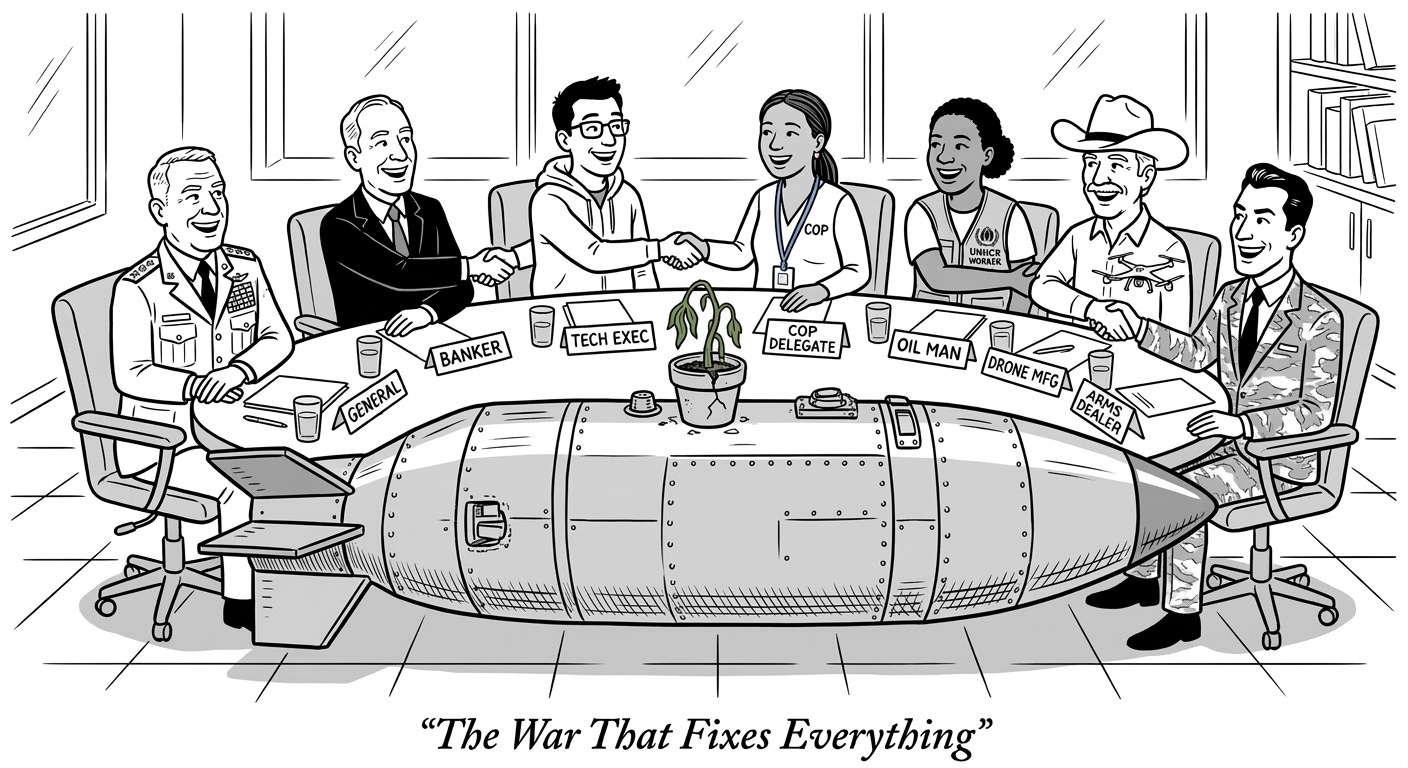
You know what twenty-eight COPs couldn’t do? Phase out fossil fuels. Twenty-eight conferences. Thirty years. 40,000 delegates per event flying business class to discuss carbon emissions. Not one binding phase-out.
One war did it in four days.
Strait of Hormuz mined. Red Sea shipping rerouted. Oil at $130. Suddenly everybody wants solar panels. Congratulations to the global climate community. You finally got your energy transition. All it took was the Fifth Fleet getting hit and insurance premiums going vertical.
So let’s celebrate. Let’s be honest, for once, about what this war accomplishes. Not what anyone says it accomplishes. What it actually does. Structurally. On the ground. Measured in outcomes that every conference, every resolution, every working group, and every blue-ribbon panel failed to deliver.
This war is the most productive policy instrument in modern history. And nobody had to vote on it.
We finally got the fossil fuel phase-out. You can’t ship oil through a mined strait. You can’t insure a tanker through a war zone. People electrify when the alternative is darkness. The Strait of Hormuz turned out to be a better climate policy than the Paris Agreement, the Kyoto Protocol, and every UNFCCC resolution combined. No compliance framework needed. No carbon tax. Just sea mines.
The population problem sorted itself out. Nobody at the UN would say the word. “Carrying capacity” was too clinical. “Depopulation” was too honest. So we said “sustainable development” and hoped the math would handle it. Well, it’s handling it. Destroy the water treatment, the desalination, the power grid, and the food import corridors of a region holding 400 million people, and the math does the talking.
To be fair, this has been a long project. The Rockefeller Foundation’s Population Council has been working on it since 1952. The Ford Foundation joined in the late fifties. The Packard and Hewlett foundations wrote the checks through the seventies. The Club of Rome published Limits to Growth in 1972 and told everyone the math was impossible. Kissinger’s NSSM-200 named thirteen countries in 1974 where population sat on top of resources the U.S. needed. The Gates Foundation picked up the baton and still puts $150 million a year into population-related grants. That’s seventy years of conferences, white papers, grants, and family planning programs, and the birth rate in the target geographies barely moved.
War moved it.
I need to stop writing like this for a second. I know people in those geographies. I know families. This section is the hardest to write in this register and I’m going to keep writing it because if the logic makes you sick, good. It should.
Five decades. Four successive instruments. The target geography persisted. The methods changed. The outcome didn’t. Fewer people sitting on top of more resources. And now the infrastructure that keeps those populations alive is being dismantled at a pace no grant program could match. The think tanks should be celebrating. Their project just got the funding it always deserved.
The dedollarization threat took care of itself. BRICS was building payment alternatives. Gulf states were settling in yuan. The dollar was losing market share for the first time since 1944. Embarrassing. But good news: chaos destroys the infrastructure that dedollarization runs on. Every missile that hits a shipping lane pushes transactions back to the one clearing system that functions under fire. Dollars. Cleared through New York. No summit required. Just turbulence.
The climate governance architecture got built overnight. The SDGs have 17 goals, 169 targets, and 231 indicators. Each indicator needs data collection. Each data collection system needs compliance infrastructure. Each compliance system needs a digital identity tied to financial access. You can’t build that during peacetime. People ask questions. But during war? Emergency measures. Temporary powers. Digital ration cards. Health passports. Carbon credits linked to energy consumption. All very reasonable during a crisis. All very permanent after it ends. If it ends.
The silver bottleneck resolved itself. Elegantly. The energy transition needs silver for solar panels, batteries, electrical contacts, and semiconductors. Supply was collapsing. COMEX was draining. China hoarded it and now has to consume it building its own grid. But if carrying capacity drops across the Middle East and South Asia, demand drops too. Fewer people means fewer phones, fewer solar installations, less industrial consumption. The supply-demand equation rebalances beautifully. Through attrition. The market clears itself. You just have to clear the people first.
Those pesky autonomous financial hubs got hollowed out. Dubai, Doha, and Riyadh were routing capital outside the dollar system. Building their own clearing infrastructure. Settling trades in currencies nobody in Washington approved. But when the region around those hubs turns into a war zone, capital does what capital always does: it runs. To London. To Singapore. To Zurich. To New York. The skylines stay. The load-bearing function drains. Beautiful from the outside. Hollow on the inside. The hubs are still there. The autonomy isn’t.
It fixes everybody’s problems. Simultaneously. That’s how you know it’s not going to stop.
The USA gets a dollar reprieve. Dedollarization infrastructure in flames. Gulf states frightened back into dependency. Continental economy riding it out behind energy self-sufficiency and agricultural surplus. South American mines developing on a ten-year timeline under cover of the chaos. The actor with the deepest buffers survives longest on a burning board. America doesn’t need to win this war. It just needs to be the last one standing when the smoke clears.
Iran gets de-sanctioned. That’s demand number one in every ceasefire proposal, and it’s beautiful in its simplicity. Forty-five years of sanctions, lifted, in exchange for absorbing some hits. Demand two: reparations. International law supports it. Destroyed hospitals, documented damage, a paper trail a mile long. Iran gets paid to rebuild what was bombed. Demand three: frozen assets unfrozen. Billions in central bank reserves held in Western accounts since 1979, released. The resistance narrative vindicated domestically. The regime consolidated. The eschatology confirmed: chaos preceded restoration, exactly as the theology predicted. Iran walks out of this with sanctions lifted, assets returned, reparations flowing, and more legitimacy than it walked in with. What a deal.
Israel gets Greater Israel. Not as a slogan anymore. As a land registry. Regional instability makes it the indispensable security partner. Abraham Accords deepen because Gulf states need the relationship more, not less. Territorial expansion proceeds under wartime cover. The settler program advances while the world watches missile trajectories. The Gulf states that were building autonomous financial architecture? Reduced. Hollowed. Dependent. Every Gulf hub that weakens is a regional competitor removed. Every Arab state that loses carrying capacity is a demographic pressure relieved. A stable Middle East is a Middle East that doesn’t need Israel. An unstable one can’t live without it. Wonderful arrangement.
Russia gets relief. Every missile fired at the Middle East is a missile not aimed at Ukraine. Every dollar spent on Hormuz is a dollar not spent on Kyiv. Western attention splits. Sanctions pressure eases because energy markets can’t handle two supply shocks at once. Trump lifts restrictions on Russian oil and LNG. Ukraine becomes yesterday’s crisis. Russia sells oil at $130 to everyone Iran can’t supply. Beautiful pivot.
Ukraine gets a trade show. Combat-tested drone technology, the spiderweb-style kamikaze systems, the FPV swarms, the autonomous loitering munitions, they now have the biggest live-fire sales catalog in history. Every military on earth is watching. Every military on earth is buying. Ukraine’s defense industry goes from survival mode to export economy. The longer the Middle East burns, the more orders come in. War as economic development. Somebody give that a TED talk.
The tech sector gets Christmas every quarter. Electrification accelerates. AI-driven warfare becomes the new procurement standard. Autonomous drones, satellite-guided targeting, real-time battlefield AI, all funded at wartime speed. Nvidia didn’t acquire Groq for $20 billion during Christmas week because business was slow. It did it because the semiconductor supply chain was about to become a matter of national survival. Every defense contract now requires AI integration. Every AI system requires chips. Every chip requires silver. The tech sector doesn’t fear this war. It feeds on it. Silicon Valley hasn’t been this excited since the internet.
Strip mining gets its golden age. Fossil fuels out, electrification in. Batteries need lithium, cobalt, graphite, rare earths. Solar needs silver, copper, tellurium. Wind needs neodymium, dysprosium. The “clean energy transition” is the largest mining boom in human history, and it just got wartime urgency. Environmental review timelines? Compressed. Community consent processes? Overridden. National security, you understand. The DRC, the Sahel, Mozambique, Myanmar, the Latin American lithium triangle: all become strategic extraction zones with security justification. The climate movement asked for a post-fossil economy. They got an open-pit mine the size of a continent. You’re welcome.
Paper money gets a reprieve. Gold and silver spike during wars. COMEX was already bleeding physical inventory. But war provides cover for delivery failure. Force majeure. National security restrictions. Exchange circuit breakers. The paper pricing mechanism that was about to collapse under arbitrage pressure gets a stay of execution because “emergency conditions” justify extraordinary measures. Cash settlement replaces physical delivery. The fiction holds a little longer. The gap between paper claims and physical reality widens, but who’s counting? Not during a war.
The dollar gets a second wind. Capital flees chaos. Capital flees to the one clearing system that functions under fire. Every disrupted corridor is a corridor that was settling in yuan, rupees, dirhams. Now it settles in dollars or it doesn’t settle at all. The dollar didn’t need to win the argument against BRICS. It needed the argument’s infrastructure to catch fire. Mission accomplished.
Shipping magnates and insurance syndicates get the best year on record. Premiums spike tenfold. Rerouting via the Cape adds $1 million per voyage. Shipping rates go vertical. The companies that own the vessels, the syndicates at Lloyd’s, the commodities traders with forward contracts, they don’t lose money during shipping disruptions. They charge more. War is a pricing event. The people who own the boats are not the people who pay the premiums. They never are.
Oil companies and futures traders get a resurrection. Oil at $130. Futures traders who went long before hostilities are printing money. Oil companies that were told they were sunset industries are suddenly strategic national assets. Windfall profits. Emergency production authorizations. Regulatory rollbacks. The “just transition” becomes “drill now, transition later.” War doesn’t kill the oil industry. It gives it a second life. A third life. However many it needs.
BlackRock and the asset management giants finally get volatility at scale. Not chaos. Volatility. The kind that reprices assets, triggers rebalancing, and generates fees on $10 trillion under management. War spikes commodity ETFs. Defense funds surge. Energy funds rebalance. ESG funds pivot to “transition minerals” without blushing. And here’s the real gift: force majeure on commodity exchanges lets paper claims settle in cash instead of physical delivery. Which is exactly what every paper-backed fund needs, because they never had the physical metal anyway. BlackRock’s iShares Silver Trust doesn’t have to deliver a single ounce. The paper fiction survives because war gave it an excuse. And when the war ends? Reconstruction contracts need financing. Sovereign debt restructuring needs arrangers. Infrastructure rebuilding needs project bonds. The asset managers don’t just survive the war. They finance whatever comes after it. War is a fee event. Peace is a flat line. Guess which one they prefer.
The climate agenda gets everything it asked for and more. Fossil fuel disruption forces electrification faster than any policy could. Reduced population in conflict zones reduces aggregate emissions. Fewer consumers, fewer emitters, fewer people requiring infrastructure that generates carbon. Every SDG gets a stronger implementation case. Emergency food systems, emergency health corridors, emergency clean energy deployment, emergency digital identity for aid distribution, emergency land use controls for refugees. War builds the case for implementing every single SDG at emergency speed, bypassing the democratic deliberation that peacetime inconveniently requires. The climate movement didn’t want this. But this is what they’re going to get.
Aviation emissions fall overnight. No carbon tax. No frequent flyer levy. Just a no-fly zone enforced by surface-to-air missiles. COP should send a thank-you card.
The defense primes get their best quarter since 2003. Lockheed Martin, Raytheon, BAE Systems, Rheinmetall, Northrop Grumman. Every Iron Dome interceptor runs $50,000 to $100,000. Every Patriot missile is $4 million. Every Tomahawk is $2 million. Iran fires cheap drones at $20,000 each and each one gets met by a multi-million dollar interceptor. The unit economics are beautiful if you’re on the selling end. Defense stocks went vertical before the first missile landed. The analysts upgraded before the smoke cleared. War is the only market condition where demand is inelastic and the customer literally cannot say no.
The refugee industry scales up. UNHCR, IOM, the major INGOs. Every displaced person is a line item. Every refugee camp needs logistics contracts, food procurement, shelter tenders, coordination staff, fleet management, and communications infrastructure. The humanitarian sector grows with suffering. More war, more displacement, more funding rounds, more institutional headcount. The people who process displacement are not the people who stop it. Their budgets depend on the distinction.
The surveillance sector gets legal cover for everything it was already doing. Palantir, the Five Eyes apparatus, biometric border systems, predictive policing platforms. Wartime justifies expanded surveillance domestically and internationally. Every encrypted channel becomes a security concern. Every border becomes a biometric checkpoint. Facial recognition at scale. Communications metadata harvested in bulk. All funded at wartime speed with wartime legal cover. The infrastructure stays after the war ends. It always does.
The pharmaceutical sector books the aftermath. Wartime health emergencies, field hospital contracts, mass casualty logistics. Then the long tail: depleted uranium exposure, chemical contamination, PTSD across entire populations, chronic conditions from infrastructure collapse. The Gulf War produced thirty years of Veterans Affairs spending. This one will produce more. The medical-industrial complex doesn’t feed on the war. It feeds on the decades after.
China doesn’t fight. China invoices. Factory of the world rebuilds whatever gets destroyed. Creditor of last resort refinances whoever goes bankrupt. Buyer of Iranian oil at a discount while everyone else pays $130. Belt and Road gets reframed as reconstruction infrastructure. China’s position improves with every month the war lasts, not because it chose a side but because it chose the billing department.
India walks the tightrope and lands on both feet. Buys Russian crude at a discount, refines it, sells the products to Europe at market price. Maintains relations with all sides. Quietly becomes the manufacturing alternative to China for every Western company looking to de-risk supply chains. War makes India’s multi-alignment more valuable. Every actor needs a neutral broker. India charges the spread.
The media gets content that never expires. War is engagement. 24-hour coverage. Subscription spikes. Push notification dopamine. Every news outlet, every podcast, every Substack, every YouTube channel covering the conflict is monetizing attention that peace doesn’t generate. Viewership is a function of anxiety. Anxiety is a function of proximity to death. War delivers both at scale. Clicks per corpse. The business model that nobody will name but everybody runs.
Count the actors who benefit. Count the industries that profit. Count the agendas that advance.
Now count the actors who benefit from peace.
The list is shorter. And none of them have missiles.
Every war has winners. This one has an unusual number. But the list of what it stops is where the celebration gets quiet.
The hippies go first. I should know. I’m one of them.
The people trying to restore watersheds, rebuild soil, replant forests, increase the carrying capacity of degraded land. The ones who think abundance is possible if you repair the water cycle and let biology do the work. War redirects every dollar of climate finance from restoration to emergency response. From building carrying capacity to managing refugees. From planting trees to deploying drones.
The restoration economy doesn’t have a lobby, a procurement budget, or a defense contract. It has shovels and rainfall data. War makes shovels irrelevant.
Independent trade dies quietly. The bilateral payment channels, the local currency settlements, the community-scale barter networks, the hawala systems that moved money across borders for a thousand years without asking permission from SWIFT. War requires financial surveillance. Emergency measures require transaction monitoring. “Know your customer” becomes “know your enemy.” Every independent channel is a potential sanctions evasion route. Every informal system is a security threat. War gives the compliance architecture the justification it needed to shut down every channel that doesn’t run through a central ledger.
Independent money becomes a security threat. Community currencies. Gold-backed settlement. Commodity-linked tokens. The experiments in money that doesn’t require a central bank’s permission to exist. War requires monetary control. Capital controls. Exchange restrictions. Emergency powers over financial flows. Every alternative to central bank money is now a national security concern. The CBDC doesn’t need to be popular. It just needs to be the only thing that works when everything else is frozen.
Small finance gets absorbed. Cooperative banks. Credit unions. Peer-to-peer lending. Mutual aid funds. Waqf-based Islamic endowments. The financial institutions that operate outside the commercial banking system and don’t need quarterly earnings to justify their existence. War-era regulations consolidate the banking sector. Small institutions can’t meet compliance costs. Emergency lending programs route through major banks. The big get bigger. The small get absorbed or shut down. Efficiency.
Abundance becomes structurally impossible. This is the quiet one. The carrying capacity of the planet is not fixed. It can be increased. Restored watersheds produce more water. Healthy soil produces more food. Functioning forests regulate rainfall across continents. The planet can support more people, better fed, with less extraction, if you repair the systems that generate abundance. War does the opposite. It reduces carrying capacity. Destroys the infrastructure that supports density. Fragments the supply chains that distribute surplus. Scarcity is not a natural condition. It is an engineered one. And war is the most efficient scarcity engine ever built.
Big tech becomes permanent. Decentralized communication. Mesh networks. Community-owned data. Open-source tools that don’t require a platform or a terms-of-service agreement. The people building digital autonomy outside the surveillance stack. War requires information control. Emergency powers require platform compliance. Mesh networks become security threats. Encrypted communication becomes suspicious. Open-source tools don’t have a compliance department. The tech giants don’t just survive wartime regulation. They become the regulation. The contract. The infrastructure. Try building a mesh network when the spectrum is commandeered for military use.
Farmers become customers. War disrupts agricultural supply chains. Fertilizer prices spike. Grain shipments halt. Smallholder farmers in the Global South can’t afford inputs. They sell land. Agribusiness consolidates. The food system centralizes further. Compliance-conditioned food aid replaces autonomous farming. The emergency creates the dependency the governance framework needed but couldn’t build during peacetime. Every farmer who loses a season is a farmer who becomes a customer.
The sky gets locked. Weaponized drones at proxy level trigger airspace security regimes everywhere. Licensing. Registration. Real-time tracking. Geofencing. Restricted zones. Operator certification. The compliance architecture doesn’t distinguish between a kamikaze FPV and a $500 agricultural drone mapping a watershed. It distinguishes between licensed and unlicensed. The small restoration outfit running three drones over degraded terrain in the Sahel now needs permits, registered flight plans, spectrum allocation, and operator credentials. The compliance cost prices out exactly the actors who were using drones for repair. Meanwhile Lockheed’s autonomous systems fly wherever the contract says. The sky gets locked the same way the spectrum got locked, the same way the financial system got locked. Open access becomes licensed access. Licensed access becomes a barrier that selects for scale. The restoration economy just lost its most cost-effective tool at exactly the moment the war economy scaled that same tool to saturation.
Journalism dies of access. Real investigative reporting gets replaced by embed coverage and source-dependent access journalism. Independent reporters become security risks. Verification takes months. The news cycle runs on military spokespeople and approved footage. The information pipeline centralizes through the same institutions the war benefits. The public knows what the pipeline delivers. Nothing else.
Verification itself becomes impossible. The region is so saturated with overlapping conflicts that any event can be attributed to any actor. The fog is permanent. Retaliation takes hours. Investigation takes months. The 72-hour window between provocation and response that might prevent the next escalation never opens. Every false flag works because nobody has time to check before the next one drops. The fire feeds itself.
The war helps every actor with power, every industry with scale, every agenda with institutional backing, and every system that runs on centralized control.
The war stops every actor with shovels, every community with autonomy, every system that runs on trust instead of compliance, and every person who thinks the planet can be repaired rather than managed.
That’s not a coincidence. That’s a structural selection mechanism. War selects for scale, centralization, and control. Peace selects for autonomy, distribution, and repair.
Now you know why peace doesn’t have a lobby.
The war that the world needs but doesn’t want to admit.
And if it ends?
It may end. Wars do. But they don’t end before the infrastructure is in place. The surveillance architecture. The digital identity layer. The airspace licensing regime. The consolidated banking sector. The centralized food system. The compliance-conditioned aid pipelines. The emergency powers that never get repealed. The spectrum locked down. The sky locked down. The money locked down.
The war ends when enough of this is built that it doesn’t need the war anymore. The emergency measures become permanent infrastructure. The wartime exceptions become peacetime standards. The temporary powers become the operating system.
The war doesn’t end with a peace deal. It ends with a delivery.
And then there’s peace. Beautiful, supervised, compliant peace. The kind where everything works as long as you have your credentials, your digital wallet is active, your carbon account is in good standing, your drone license is current, and your food ration card is linked to your biometric ID. Peace. On the grid. Under the architecture that war built.
That’s the peace they’ll offer. That’s the peace most people will accept. Because by then the alternative infrastructure, the autonomous systems, the independent food, the free sky, the community finance, the restored watersheds, will have been defunded, delicensed, or priced out of existence during the emergency.
Unless someone builds it anyway.
Now.
I don’t believe a word of the celebration above. I believe every word of the structural mechanics underneath it.
You just read through twenty-something structural outcomes that all benefit centralized power. Not one of them required anyone to sit in a room and plan it. Convergent destruction from divergent intent. That’s the part that should keep you up at night. Not a conspiracy. A structure. Structures don’t need meetings. They just need coupled systems and self-interested actors on the same terrain.
And stop scoring this as one president's blunder or one president's masterstroke. I'm tired of that conversation. This war, or something structurally identical to it, was coming regardless of who sat in the chair. Six presidents watched the same debt curve steepen. The same reserve currency erode. The same energy corridors threaten to settle in yuan. The same demographic math eat the entitlement budget. None of them reversed it. Not because they were stupid. Because the trajectory is not a policy failure. It is what happens to a system that requires expanding credit to service existing debt and requires military enforcement to protect the currency that denominates that debt. Clinton didn't fix it. Bush accelerated it. Obama managed it. Trump 1 ignored it. Biden inherited it. Trump 2 pulled the trigger. The trigger was discretionary. The gun was loaded before any of them took office.
People are dying under this. Families in southern Iran who had nothing to do with any of this are drinking from broken mains. Desalination plants in the Gulf are offline. Hospitals in Bandar Abbas are running on generators that will run out. Gaza is already past the point where the word “crisis” means anything. The West Bank is being annexed in real time while the cameras point at missile trajectories. Lebanon is being hit by the IDF again, a country that was already broken, now getting broken further because the geography is convenient. The corridors that fed 400 million people are closed and nobody is talking about what happens to those people in ninety days. The capital is already gone. It left the first week.
And somehow, while all of this burns, Pakistan and Afghanistan are at each other’s throats. Suicide drones fly over the skies of Islamabad. Kabul gets bombed. We don’t have a beef with the people of Afghanistan. They don’t have a beef with us. Our families are intermarried across that border. We share food, language, grief. But the structural logic needs the periphery destabilized, and here we are, two countries that should be helping each other through the worst energy shock in a generation instead spending blood and treasure on a fight that serves neither.
And here in Islamabad, where nobody fired a missile at Iran, cooking oil is up 40% since February. Flour prices are climbing. The rupee is sliding against the dollar because Pakistan imports 85% of its oil and the strait it comes through is shut. My neighbours are not geopolitical actors. They are trying to figure out how to feed their families next month. That’s what structural violence looks like at the receiving end. No explosion. Just prices.
My stance from day one: de-escalation. Because the fire doesn’t serve who people think it serves. It serves the terrain’s destruction. And the terrain is where the rest of us live.
If you’re scoring this war as wins and losses for named actors, you’re watching the wrong game. The game is the board itself. And the board is burning.
The counter is not a competing army. It’s a competing substrate. Restored watersheds. Distributed food systems. Autonomous energy. Communities that can feed, water, and power themselves without asking permission from any grid, any currency, or any messiah.
The fire burns what depends on the grid. What is rooted in the land survives.